In public discourse, GLP-1 receptor agonists are frequently depicted as universally effective therapies that dissolve appetite with algorithmic certainty.
Yet every practicing clinician in obesity medicine has encountered a perplexing patient subset: individuals who escalate semaglutide or tirzepatide to maximum tolerated doses, report no satiety enhancement, and experience virtually zero weight loss.
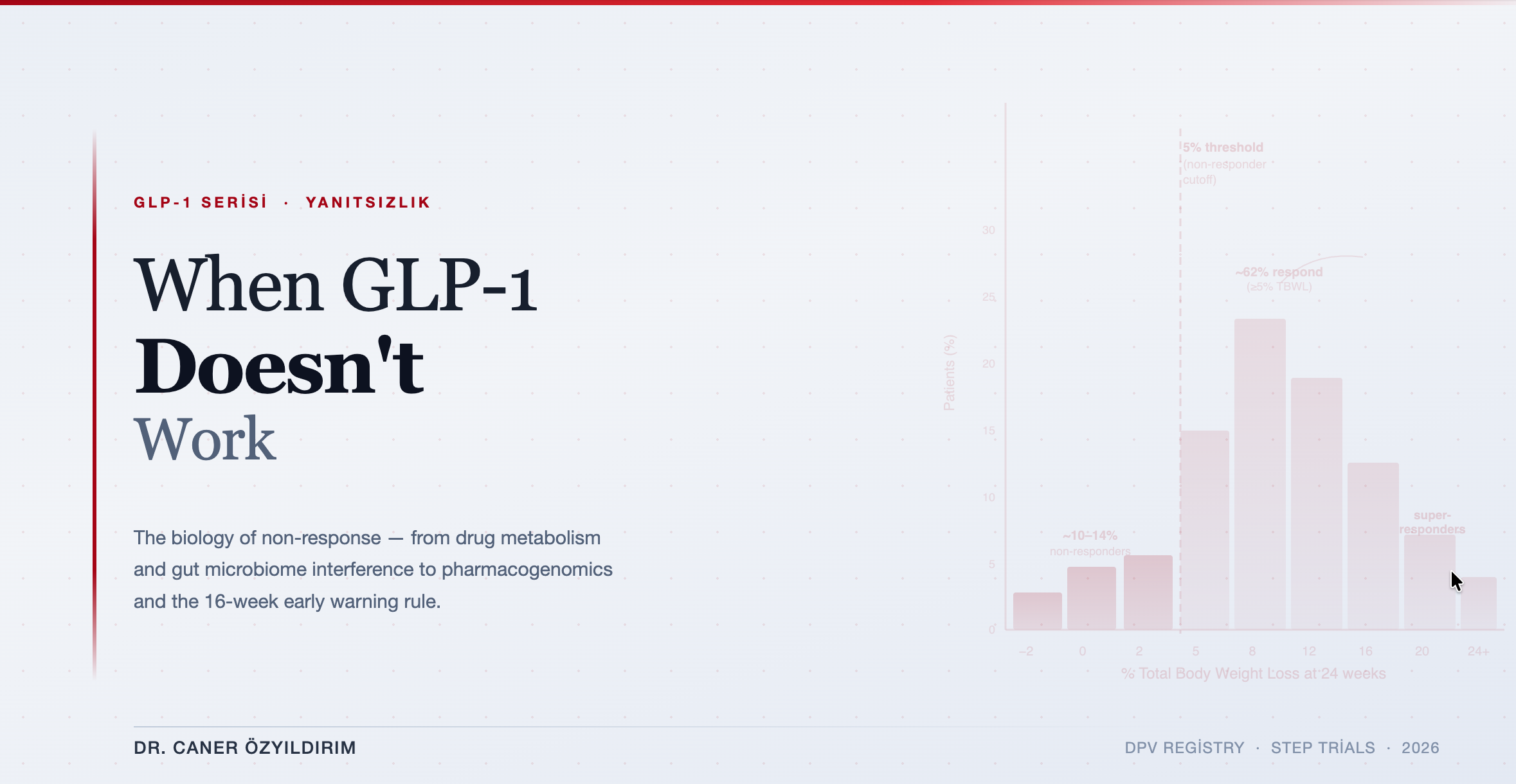
Large randomized clinical trials substantiate this reality: across the STEP and SURPASS programs, approximately 10% to 15% of participants are classified as "non-responders," failing to achieve even a modest 5% total body weight reduction.
What biological and clinical mechanisms drive GLP-1 resistance?
1. Defining Non-Response in Clinical Practice
According to international guidelines (including EASO and the ADA), clinical non-response is formalised as:
*A failure to lose at least 5% of baseline body weight after 12 to 16 weeks on the maximum tolerated therapeutic dose of a GLP-1 receptor agonist.*
Before assuming biological resistance, clinicians must rule out two fundamental confounding variables:
- Medication Adherence & Storage: Subcutaneous injection technique failures, improper pen activation, or cold-chain storage breaks that denature the peptide.
- Concomitant Weight-Positive Pharmacotherapy: Concurrent use of obesogenic agents (insulin, sulfonylureas, beta-blockers, tricyclic antidepressants, atypical antipsychotics like olanzapine, or systemically absorbed corticosteroids).
2. Genomic & Receptor Polymorphisms
The first biological bottleneck occurs at the receptor interface:
- GLP1R Genetic Variants: Genome-wide association studies (GWAS) have identified single-nucleotide polymorphisms (SNPs) within the GLP1R gene (such as rs1042044) that significantly blunt receptor binding affinity and downstream intracellular cAMP generation.
- Downstream Melanocortin Pathway Mutations: GLP-1 suppresses appetite by activating pro-opiomelanocortin (POMC) neurons, which release alpha-MSH to stimulate the Melanocortin-4 Receptor (MC4R). Patients carrying heterozygous loss-of-function variants in *MC4R* or *POMC* exhibit profound resistance to GLP-1-mediated central satiety.
3. Severe Baseline Insulin Resistance & Lipotoxicity
Patients with long-standing, poorly controlled type 2 diabetes and profound hepatic steatosis consistently experience 30% to 50% less weight reduction on incretin therapies compared to individuals without dysglycemia.
Chronic central neuroinflammation and hypothalamic microgliosis triggered by saturated fatty acids (e.g., palmitate) impair hypothalamic receptor signaling, desensitizing central circuits to peripheral hormonal satiety inputs.
4. Behavioral & Dietary Subversion
GLP-1 agonists dramatically slow gastric emptying for solid foods. However, patients who habitually consume liquid calories, ultra-processed ultra-palatable foods, and constant grazing snacks can effortlessly bypass gastric stretch receptor signaling.
Because liquids and highly refined starches empty rapidly even through a pharmacologically slowed pylorus, hedonic hyper-palatable eating easily overrides homeostatic incretin cues.
1. Audit injection fidelity and eliminate obesogenic co-medications.
2. Switch to multi-incretin molecules (e.g., transitioning from a pure GLP-1 agonist to dual GLP-1/GIP tirzepatide or forthcoming GLP-1/GIP/Glucagon retatrutide).
3. Provide structured Medical Nutrition Therapy (MNT) targeting meal architecture, eliminating liquid calories, and restoring dietary protein density.